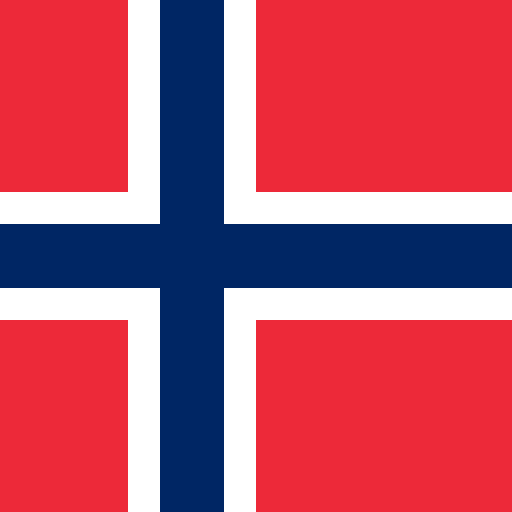
Flags of Central America
Central America is a narrow strip of land connecting North and South America, made up of seven countries. Many of these flags share blue and white colors - a legacy of the former Federal Republic of Central America. Let's explore each flag and discover what makes it unique.
Study the Flags
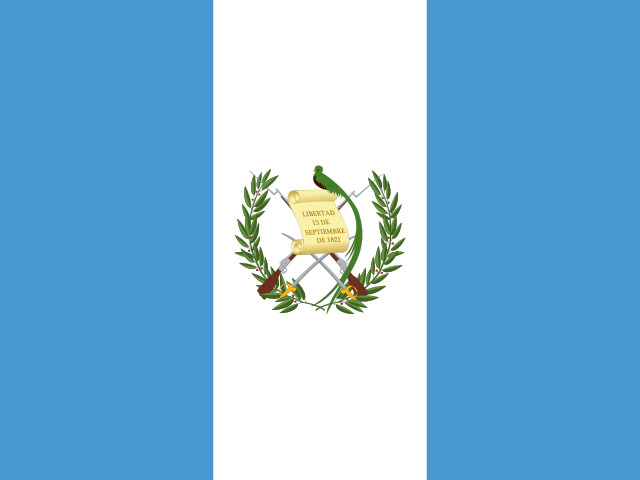
Guatemala
Capital: Guatemala City
Three vertical stripes: sky blue, white, sky blue. The coat of arms in the center features a quetzal bird, a scroll, and crossed rifles.
Adopted: 1871
Fun Facts
- The quetzal bird on the coat of arms is a symbol of liberty - it dies in captivity
- The sky blue stripes represent the Pacific Ocean and Caribbean Sea
- Guatemala means "land of trees" in the Mayan language
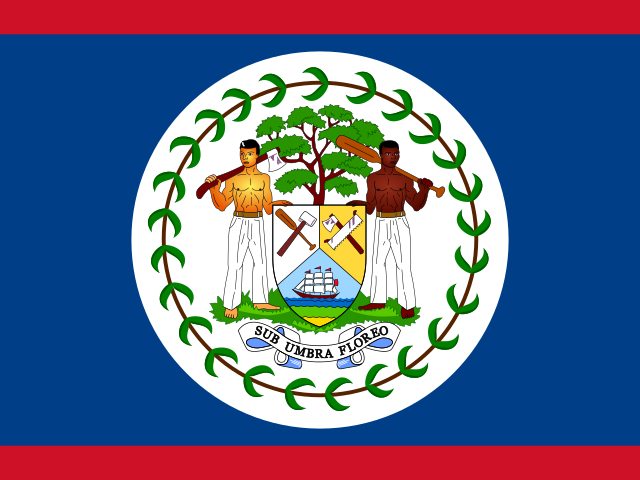
Belize
Capital: Belmopan
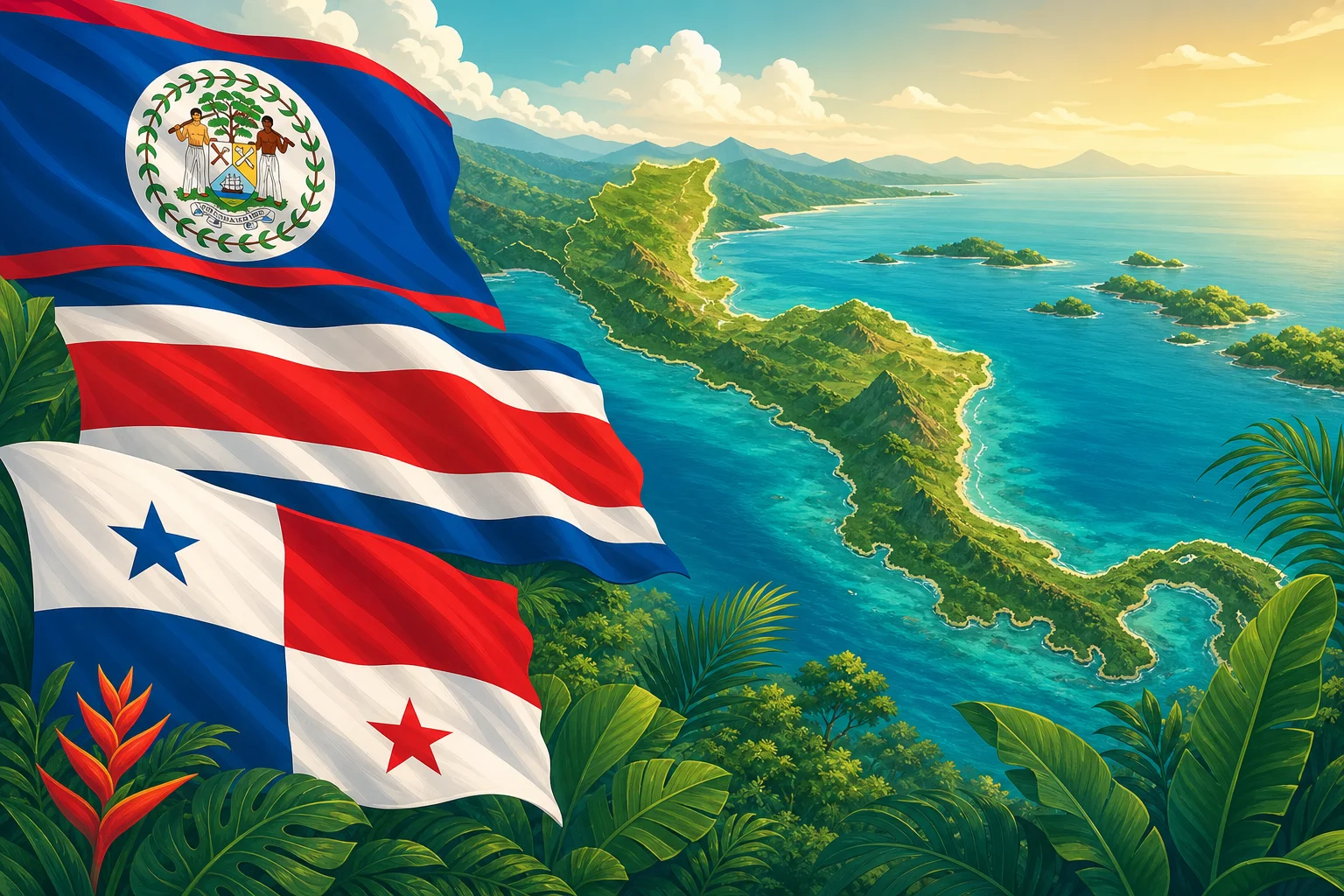
Royal blue field with a white circle containing the coat of arms, bordered by thin red stripes at top and bottom.
Adopted: 1981
Fun Facts
- Belize has the only national flag in the world that prominently features humans
- The 50 leaves in the wreath represent 1950, when the independence movement began
- The red stripes were added in 1950 to represent the opposition party
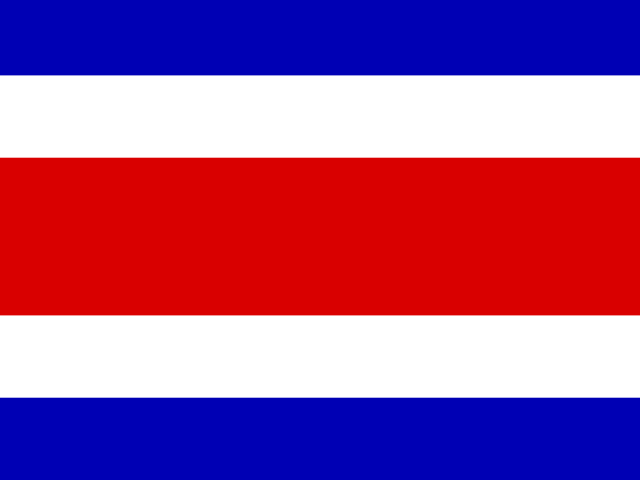
Costa Rica
Capital: San Jose
Five horizontal stripes: blue, white, red (double width), white, blue. The coat of arms appears on the left side of the red stripe.
Adopted: 1906
Fun Facts
- Costa Rica abolished its army in 1948 - one of few countries with no military
- The red stripe represents the blood shed for freedom and the warmth of the people
- The coat of arms shows three volcanoes representing the country's mountain ranges
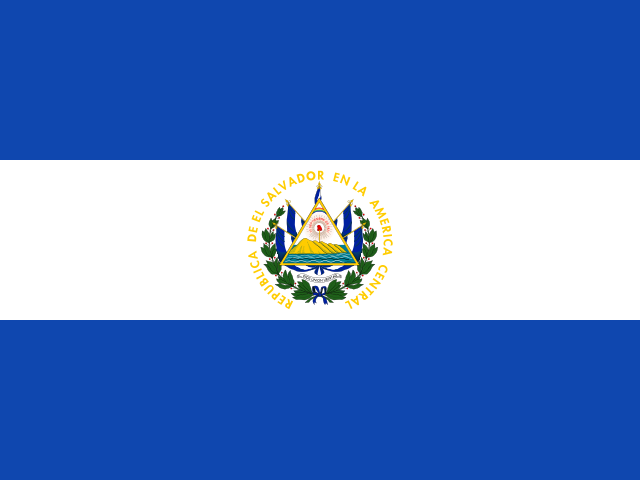
El Salvador
Capital: San Salvador
Three horizontal stripes: cobalt blue, white, cobalt blue. The national coat of arms centered on the white stripe.
Adopted: 1912
Fun Facts
- The triangle on the coat of arms represents equality, and the five volcanoes represent the five Central American nations
- El Salvador is the smallest and most densely populated country in Central America
- The cobalt blue represents the sky and two oceans bordering Central America
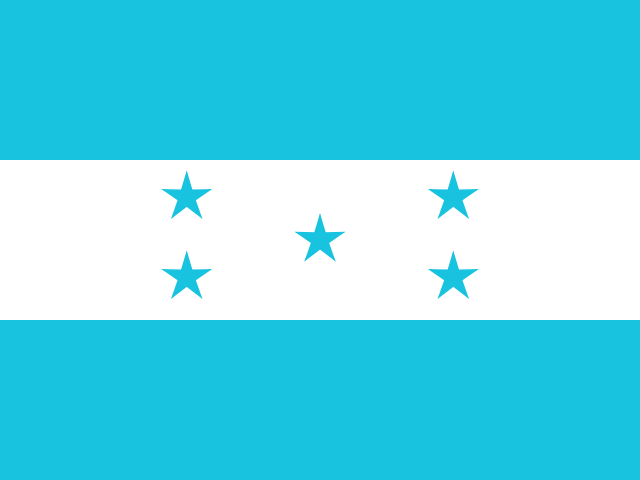
Honduras
Capital: Tegucigalpa
Three horizontal stripes: turquoise blue, white, turquoise blue. Five blue stars arranged in an X pattern on the white stripe.
Adopted: 1949
Fun Facts
- The five stars represent the five nations of the former Federal Republic of Central America
- Honduras means "depths" in Spanish - Columbus named it for the deep waters off the coast
- The turquoise blue represents the Caribbean Sea and Pacific Ocean
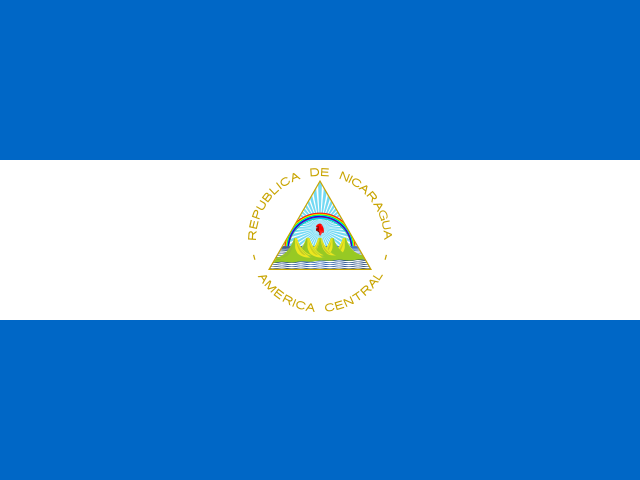
Nicaragua
Capital: Managua
Three horizontal stripes: blue, white, blue. The national coat of arms centered on the white stripe features a triangle with five volcanoes and a rainbow.
Adopted: 1971
Fun Facts
- Nicaragua's flag is one of only two national flags that include purple (the rainbow in the coat of arms)
- The triangle represents equality among all people
- The coat of arms shows five volcanoes representing the original five member states
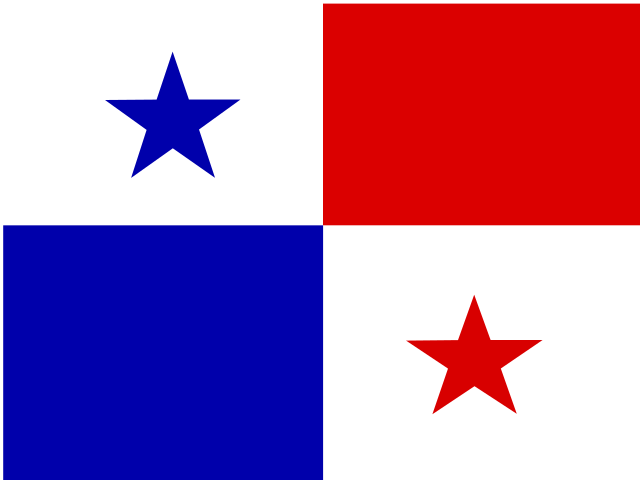
Panama
Capital: Panama City
Four quarters: white with blue star (top-left), red (top-right), blue (bottom-left), white with red star (bottom-right).
Adopted: 1925
Fun Facts
- The flag was designed by Manuel Amador Guerrero, Panama's first president
- Blue represents the Conservative Party, red the Liberal Party, and white peace between them
- The blue star stands for purity and honesty, the red star for authority and law
Quick Reference
Test Your Knowledge
Think you can remember these flags? Take this quick quiz to find out.
Practice with Games
Ready to test what you learned? Jump into a game and put it into practice.
About Central American Flags
The flags of Central America share a fascinating common heritage. Five of the seven countries - Guatemala, El Salvador, Honduras, Nicaragua, and Costa Rica - were once part of the Federal Republic of Central America (1823-1841). This shared history explains why many of these flags feature blue and white stripes, representing the Pacific Ocean and Caribbean Sea that border the isthmus. Belize and Panama, which were not part of the federation, have distinctly different flag designs that reflect their unique colonial histories.
Frequently Asked Questions
Why do so many Central American flags look similar?
Five Central American countries (Guatemala, El Salvador, Honduras, Nicaragua, and Costa Rica) were once united as the Federal Republic of Central America. Their blue-white-blue stripe pattern comes from this shared heritage, though each country has added unique elements to distinguish their flag.
How many countries are in Central America?
There are 7 countries in Central America: Belize, Costa Rica, El Salvador, Guatemala, Honduras, Nicaragua, and Panama. Together they form the land bridge between North and South America.
Which Central American flag is the most unique?
Belize's flag is the most distinctive - it features humans (woodcutters) prominently on its coat of arms and is the only national flag in the world to do so. Panama's quartered design also stands out from the blue-white-blue pattern of the other five.