Map of Central Asia: All 5 Countries and Capitals
Central Asia is a vast landlocked region stretching from the Caspian Sea in the west to China in the east. These five countries, often called the "Stans," gained independence after the dissolution of the Soviet Union in 1991. The region features diverse geography from the steppes of Kazakhstan to the towering peaks of the Pamir Mountains. Below the interactive map you will find a complete list of all 5 countries with their capitals, plus study cards to help you learn each one.
Hover a country to see its name. Click to jump to its study card.
The 5 Countries of Central Asia and Their Capitals
Complete list of all countries in Central Asia with capital, population and area. Click a country to jump to its study card with map and facts.
| Country | Capital | Population | Area |
|---|---|---|---|
 Kazakhstan Kazakhstan | Astana | 20.1M | 2,724,900 km² |
 Kyrgyzstan Kyrgyzstan | Bishkek | 7.1M | 199,951 km² |
 Tajikistan Tajikistan | Dushanbe | 10.1M | 143,100 km² |
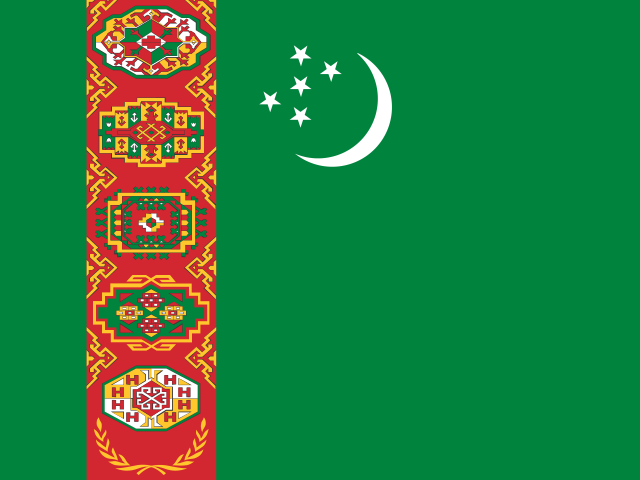 Turkmenistan Turkmenistan | Ashgabat | 6.5M | 488,100 km² |
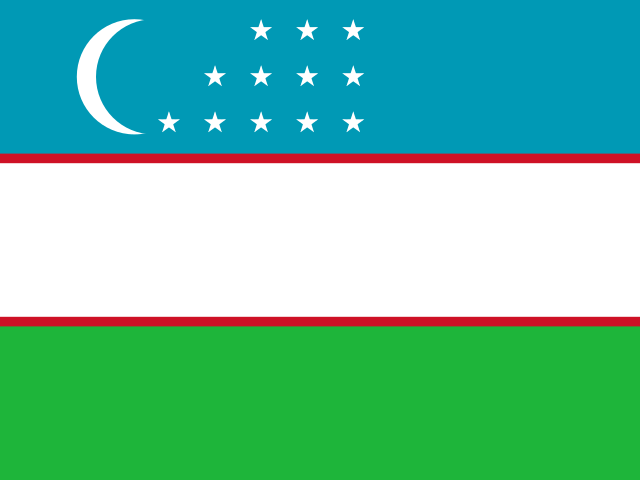 Uzbekistan Uzbekistan | Tashkent | 36.4M | 448,978 km² |
Study the Countries
Kazakhstan
Borders: Russia, China, Kyrgyzstan, Uzbekistan, Turkmenistan
Area: 2,724,900 km² · Landlocked
Kazakhstan is the largest landlocked country in the world and the ninth-largest country overall. It stretches from the Caspian Sea in the west to the Altai Mountains in the east, bordered by Russia to the north and China to the southeast. The terrain includes vast steppes, deserts, and mountain ranges along its southern and eastern borders.
Shape: A massive, roughly rectangular country dominating the northern part of Central Asia, with an irregular western border along the Caspian Sea.
Fun Facts
- Kazakhstan is the largest landlocked country in the world by area.
- The Aral Sea, once the fourth-largest lake in the world, lies on Kazakhstan's border with Uzbekistan.
- Kazakhstan shares its longest border with Russia at over 7,600 km.
Kyrgyzstan
Borders: Kazakhstan, Uzbekistan, Tajikistan, China
Area: 199,951 km² · Landlocked
Kyrgyzstan is a mountainous country in eastern Central Asia, bordered by Kazakhstan to the north, Uzbekistan to the west, Tajikistan to the south, and China to the east. Over 80% of the country is covered by the Tian Shan mountain range. Lake Issyk-Kul, one of the largest alpine lakes in the world, lies in the northeast.
Shape: A small, roughly oval country nestled in the mountains between Kazakhstan to the north and Tajikistan to the south.
Fun Facts
- Over 80% of Kyrgyzstan is covered by mountains, with peaks reaching over 7,000 meters.
- Lake Issyk-Kul is the second-largest alpine lake in the world and never freezes despite being surrounded by mountains.
- Kyrgyzstan is bordered by four countries but has no access to any ocean.
Tajikistan
Borders: Kyrgyzstan, Uzbekistan, Afghanistan, China
Area: 143,100 km² · Landlocked
Tajikistan is the smallest Central Asian country by area, located in the southeast of the region. It is bordered by Kyrgyzstan to the north, Uzbekistan to the west, Afghanistan to the south, and China to the east. The country is extremely mountainous, with the Pamir Mountains covering the eastern half, earning it the nickname "Roof of the World."
Shape: An irregularly shaped country in the southeast of Central Asia, with a long panhandle extending eastward into the Pamir Mountains.
Fun Facts
- Tajikistan is the smallest Central Asian country but has the highest peak, Ismoil Somoni at 7,495 meters.
- Over 93% of Tajikistan is mountainous terrain.
- The Fedchenko Glacier in Tajikistan is the longest glacier outside the polar regions.
Turkmenistan
Borders: Kazakhstan, Uzbekistan, Afghanistan, Iran
Area: 488,100 km² · Coastline: 1,768 km
Turkmenistan occupies the southwestern portion of Central Asia, bordered by the Caspian Sea to the west, Kazakhstan to the north, Uzbekistan to the northeast, Afghanistan to the southeast, and Iran to the south. About 80% of the country is covered by the Karakum Desert, one of the world's largest sand deserts.
Shape: A large, irregularly shaped country in the southwest of Central Asia, with a long western coastline along the Caspian Sea.
Fun Facts
- The Karakum Desert covers about 80% of Turkmenistan's territory.
- Turkmenistan has a coastline on the Caspian Sea, the world's largest inland body of water.
- The Darvaza Gas Crater, known as the "Door to Hell," has been burning continuously since 1971.
Uzbekistan
Borders: Kazakhstan, Kyrgyzstan, Tajikistan, Afghanistan, Turkmenistan
Area: 448,978 km² · Landlocked
Uzbekistan is located in the heart of Central Asia, bordered by all four other Central Asian countries and Afghanistan. It is one of only two doubly landlocked countries in the world. The landscape transitions from desert plains in the west to fertile valleys in the east, including the Fergana Valley.
Shape: A centrally positioned country in Central Asia, roughly shaped like a crouching animal with an elongated eastern portion reaching into the Fergana Valley.
Fun Facts
- Uzbekistan is one of only two doubly landlocked countries in the world (the other is Liechtenstein).
- Uzbekistan borders all four other Central Asian countries.
- The ancient Silk Road cities of Samarkand, Bukhara, and Khiva are all in Uzbekistan.
Quick Reference
Test Your Knowledge
Can you identify these countries on the map?
Practice with Games
Ready to test what you learned? Jump into a game and put it into practice.
About Central Asia Geography
Central Asia encompasses five nations stretching from the Caspian Sea to China, covering over 4 million square kilometers of steppes, deserts, and mountain ranges. The region sits at the crossroads of historic trade routes including the Silk Road, and its geography ranges from the flat Kazakh Steppe to the towering Pamir and Tian Shan mountain ranges.
Frequently Asked Questions
How many countries are in Central Asia?
There are 5 countries in Central Asia: Kazakhstan, Kyrgyzstan, Tajikistan, Turkmenistan, and Uzbekistan. All gained independence after the dissolution of the Soviet Union in 1991.
Which is the largest Central Asian country?
Kazakhstan is the largest Central Asian country and the largest landlocked country in the world, covering approximately 2,724,900 km².
Are all Central Asian countries landlocked?
All five Central Asian countries are landlocked, though Kazakhstan and Turkmenistan border the Caspian Sea, which is the world's largest enclosed inland body of water.
Which countries and capitals are in Central Asia?
The 5 countries of Central Asia and their capitals are: Kazakhstan (Astana), Kyrgyzstan (Bishkek), Tajikistan (Dushanbe), Turkmenistan (Ashgabat), Uzbekistan (Tashkent).
Are the Central Asian countries former Soviet republics?
Yes. Kazakhstan, Kyrgyzstan, Tajikistan, Turkmenistan and Uzbekistan were all republics of the Soviet Union until 1991, which is why Russian is still widely spoken across the region.