Learn the Currencies of North America
North America is dominated by three large economies, each with its own currency. The United States uses the US dollar, the world's leading reserve currency, while Canada has the Canadian dollar and Mexico the Mexican peso. This lesson covers the currency of all 3 North American countries, with each currency code, symbol and the year it came into use.
Study the Currencies
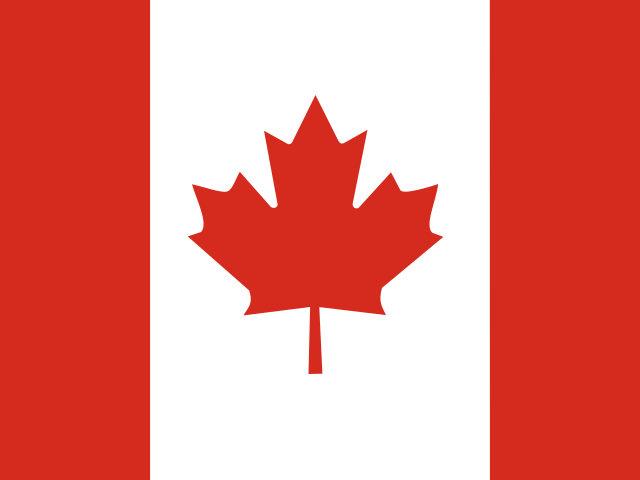 CAD
CAD Canada
Canadian dollar
Canada uses the Canadian dollar, often nicknamed the loonie after the bird on its one-dollar coin.
Fun Facts
- The one-dollar coin is called the loonie because it features a common loon, and the two-dollar coin is the toonie.
- To tell it apart from the US dollar, the Canadian dollar is often written C$ or CA$.
- Canada was one of the first countries to remove its lowest coin, retiring the penny in 2013.
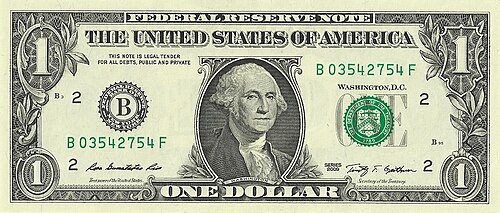 USD
USD United States
US dollar
The United States uses the US dollar, the world's primary reserve currency and the most traded currency on Earth.
Fun Facts
- The US dollar is the world's leading reserve currency, held by central banks around the globe.
- It was established by the Coinage Act of 1792, making it one of the oldest currencies still in use.
- The dollar is also the official currency of several other countries, including Ecuador and El Salvador.
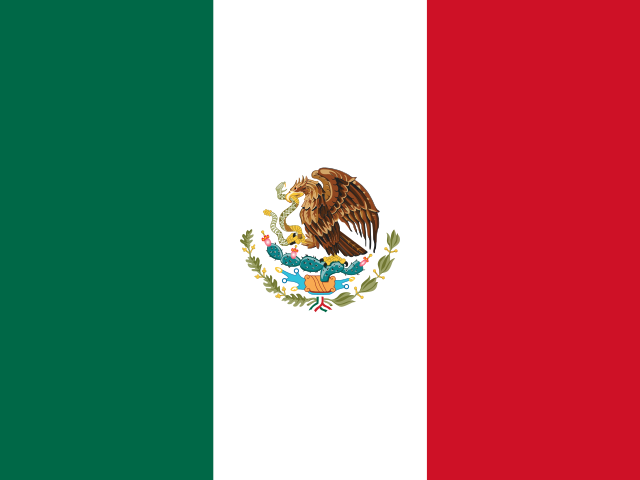 MXN
MXN Mexico
Mexican peso
Mexico uses the peso, one of the oldest currencies in the Americas, redenominated as the nuevo peso in 1993.
Fun Facts
- The dollar sign $ is thought to come from the old Spanish peso, which circulated widely in early America.
- In 1993 Mexico knocked three zeros off the peso, so 1,000 old pesos became 1 new peso.
- A peso is divided into 100 centavos.
Quick Reference
Test Your Knowledge
Can you match each country to its currency?
Practice with Games
Ready to test what you learned? Jump into a game and put it into practice.
About North American Currencies
North America has three sovereign countries, each with its own national currency. The United States uses the US dollar (USD), the world's primary reserve currency and the most widely traded money on the planet. Canada has the Canadian dollar (CAD), affectionately called the loonie after the bird on its one-dollar coin, while Mexico uses the Mexican peso (MXN), one of the oldest currencies in the Americas. All three share the dollar or peso symbol $, so codes such as USD, CAD and MXN are used to tell them apart. The dollar sign itself is widely believed to descend from the Spanish peso that circulated across the Americas in colonial times. Learning these currencies, their ISO codes and symbols makes travel, shopping and reading the news across North America far easier.
Frequently Asked Questions
How many currencies are used in North America?
North America's three sovereign countries each have their own currency: the US dollar in the United States, the Canadian dollar in Canada and the Mexican peso in Mexico.
What is the difference between the US dollar and the Canadian dollar?
They are separate currencies with different values. The US dollar (USD) is issued by the United States and is the world's main reserve currency, while the Canadian dollar (CAD) is issued by Canada and is often written C$ or CA$ to avoid confusion.
What is the currency of Mexico?
Mexico uses the Mexican peso, with the ISO code MXN. It uses the symbol $ and is divided into 100 centavos. The current peso replaced the old peso in 1993, with 1,000 old pesos becoming 1 new peso.
Why do North American currencies all use the dollar sign?
The US dollar, Canadian dollar and Mexican peso all use the symbol $, which is believed to come from the Spanish peso that circulated across the Americas. Because they share the symbol, the ISO codes USD, CAD and MXN are used to keep them apart.
Banknote images via Wikimedia Commons: USD (ESEMES, Public domain)