
🏔️ Mountain Ranges of Europe: map with names
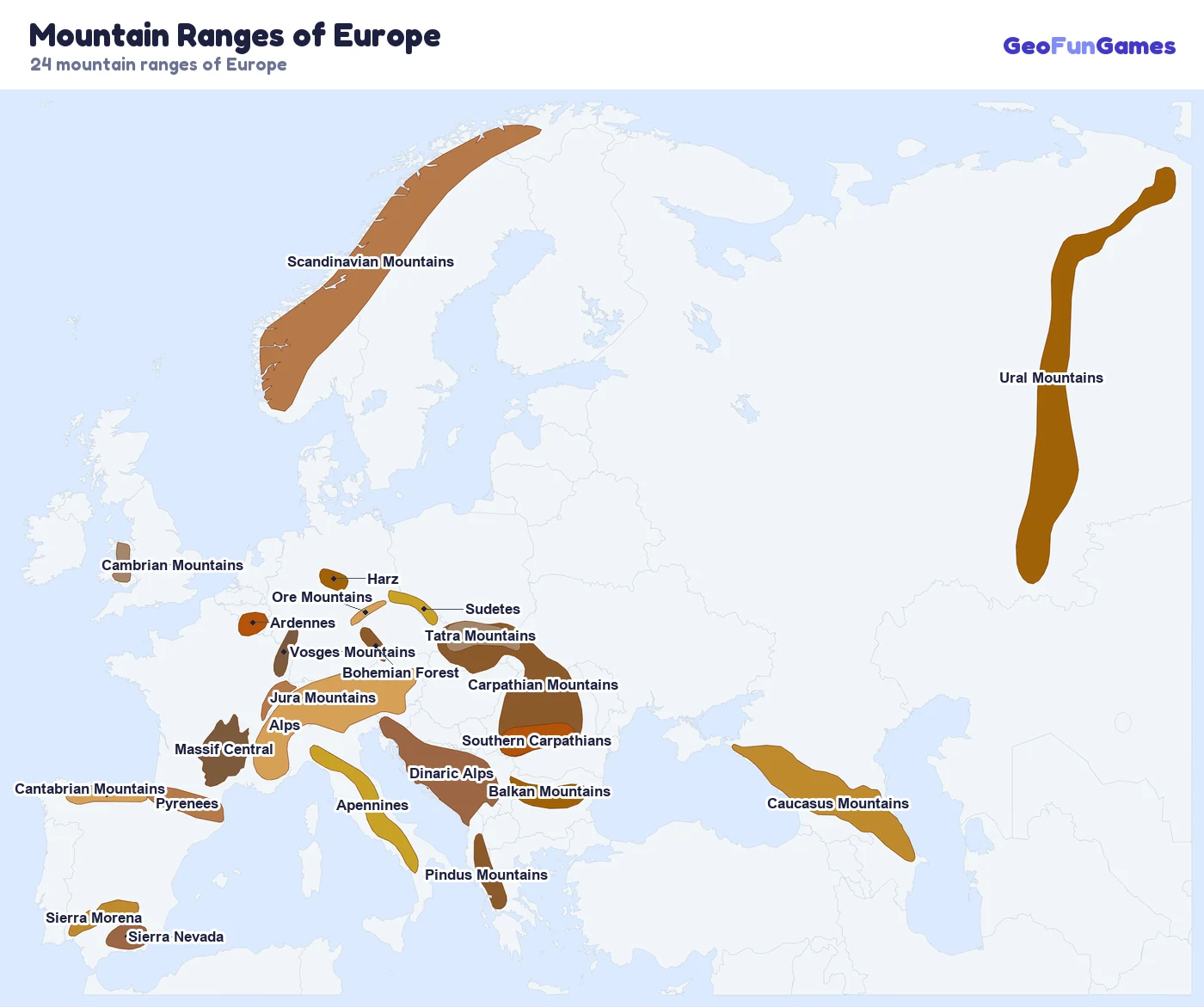
From the Alps to the Urals. Print the map, download it as a PDF, or use the blank map to practise.
About this map
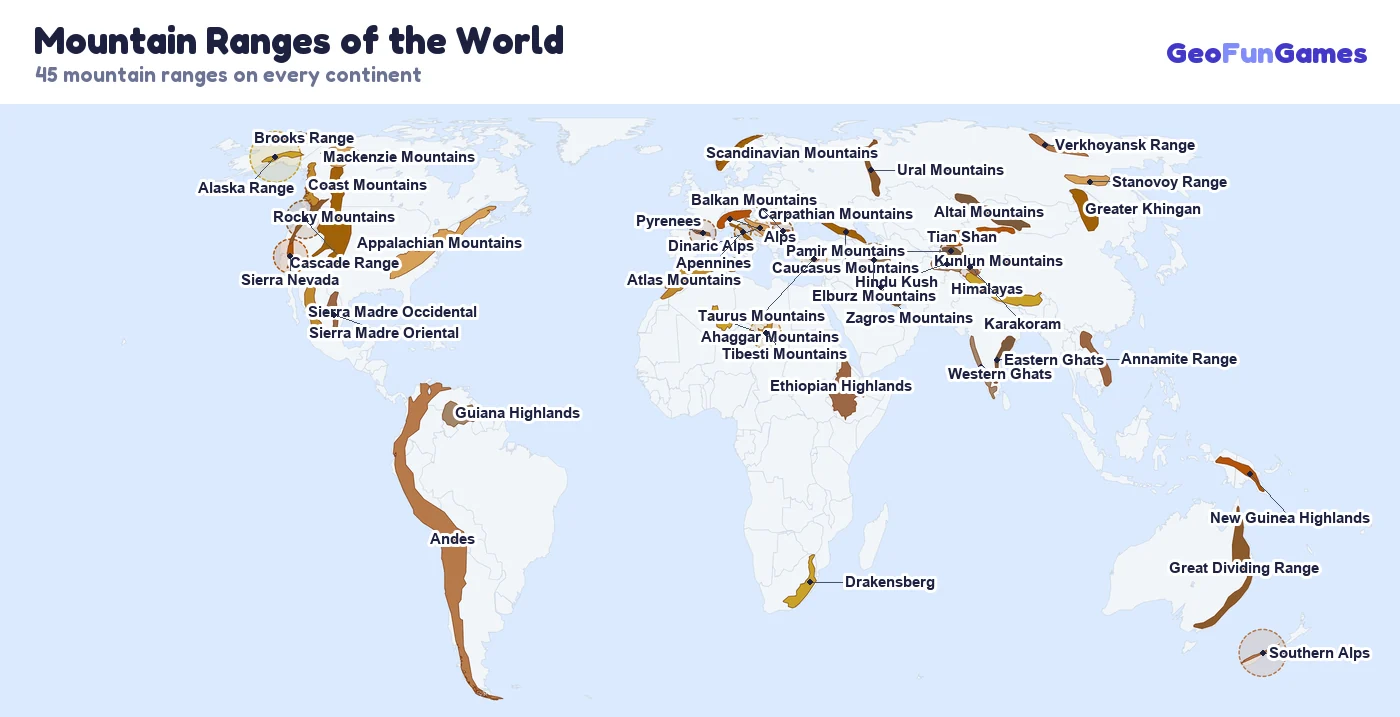
Europe's mountains run from the Arctic to the Mediterranean. The Scandinavian Mountains form the backbone of Norway, the Alps arc across the middle of the continent, and the Pyrenees, Apennines, Dinaric Alps and Balkan Mountains rise behind the southern coasts.
Many ranges are also borders: the Pyrenees between France and Spain, the Sudetes between the Czech Republic and Poland, and the Urals and the Caucasus at the edge of Europe and Asia.
Key facts
Mont Blanc
At 4,806 m, Mont Blanc in the Alps is the highest mountain in Western Europe, on the border of France and Italy.
Even higher in the east
If the Caucasus counts as Europe, Mount Elbrus (5,642 m) in Russia is the highest mountain on the continent.
Eight Alpine countries
The Alps cross France, Monaco, Italy, Switzerland, Liechtenstein, Germany, Austria and Slovenia.
A long arc
The Carpathians curve about 1,500 km through Central and Eastern Europe, mostly in Romania, Slovakia, Ukraine and Poland.
Spain's highest
Mulhacén (3,479 m) in the Sierra Nevada is the highest point of mainland Spain.
All 24 mountain ranges on the map
Level 1
The great ranges, like the Alps, Pyrenees, Carpathians and Urals
- Alps
- Pyrenees
- Carpathian Mountains
- Apennines
- Scandinavian Mountains
- Caucasus Mountains
- Ural Mountains
- Balkan Mountains
Level 2
The next 8, like the Dinaric Alps, Massif Central, Jura and Tatras
- Dinaric Alps
- Cantabrian Mountains
- Sierra Nevada
- Massif Central
- Jura Mountains
- Vosges Mountains
- Tatra Mountains
- Pindus Mountains
Level 3
Smaller ranges, like the Ardennes, Harz, Ore Mountains and Sudetes
- Ardennes
- Harz
- Ore Mountains
- Sudetes
- Southern Carpathians
- Cambrian Mountains
- Bohemian Forest
- Sierra Morena
How to learn them
Learn the big ranges first, then the smaller ones next to them. The Jura sits just north-west of the Alps and the Vosges a little further north. The Tatras are the highest part of the Carpathians, and the Southern Carpathians close their arc in Romania. Germany's low ranges, the Harz, the Ore Mountains on the Czech border and the Bohemian Forest, sit between the North Sea plain and the Alps.
Test yourself
Find every place on the map in the quiz, level by level.
Play the quizQuestions
What is the highest mountain range in Europe?
The Alps, with Mont Blanc (4,806 m) on the border of France and Italy. If the Caucasus counts as Europe, Mount Elbrus (5,642 m) in Russia is higher. The Urals mark the usual border between Europe and Asia.
Which countries do the Alps cross?
Eight: France, Monaco, Italy, Switzerland, Liechtenstein, Germany, Austria and Slovenia.
What separates Europe from Asia?
By the usual definition, the Ural Mountains, the Ural River, the Caspian Sea and the Caucasus.
What is the highest mountain in Spain?
Teide (3,715 m) on Tenerife in the Canary Islands. On the mainland it is Mulhacén (3,479 m) in the Sierra Nevada.