
🌊 Oceans and Seas: map with names
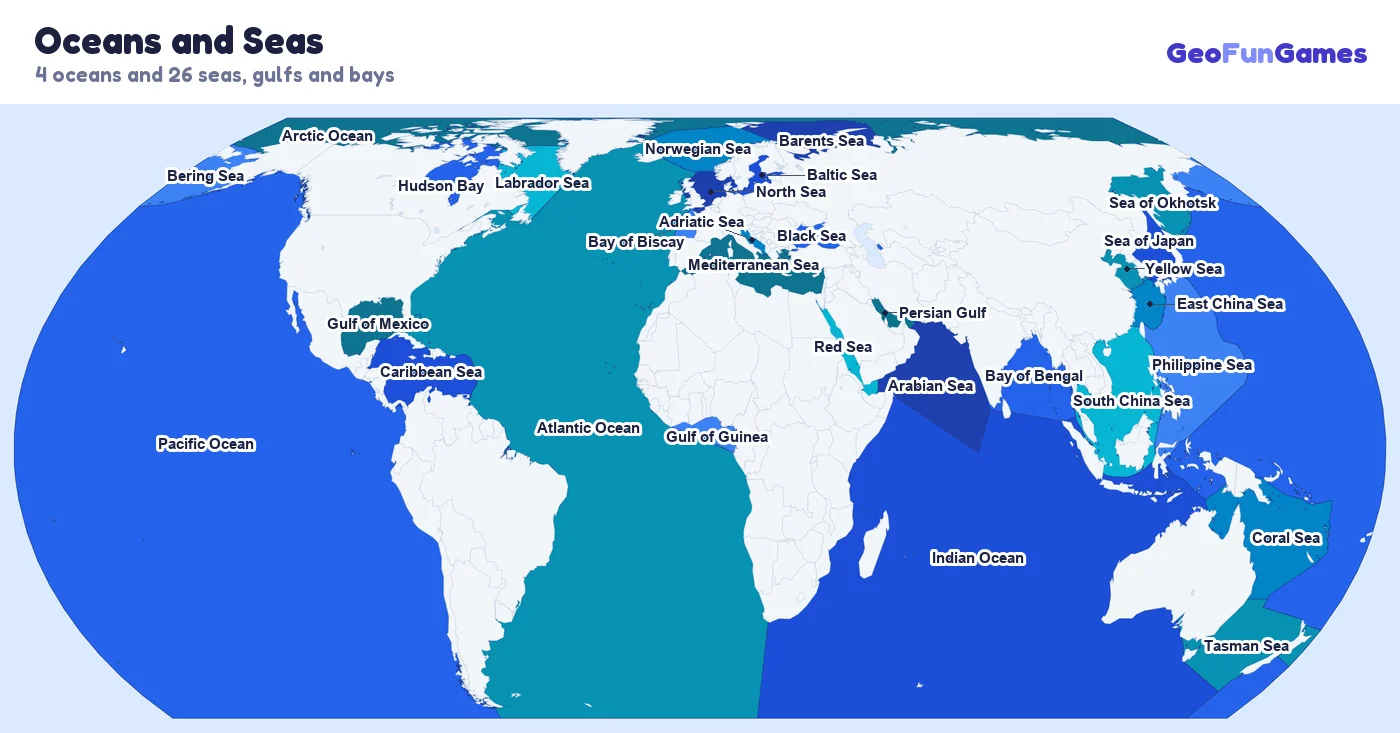
From the Pacific Ocean to the Red Sea. Print the map, download it as a PDF, or use the blank map to practise.
About this map
Oceans cover about 71% of the Earth. They are all connected, and the borders between them are drawn by people, using coasts, islands and lines of longitude.
A sea is a smaller part of an ocean, often partly closed in by land, like the Mediterranean or the Caribbean. Gulfs and bays are large inlets of the sea into the land.
Key facts
The Pacific
The Pacific covers about 165 million km², more than all the land on Earth put together.
The deepest point
The Challenger Deep in the Mariana Trench in the Pacific is about 10,935 m deep, the deepest place in the ocean.
A narrow gateway
The Mediterranean meets the Atlantic only through the Strait of Gibraltar, about 14 km wide at its narrowest.
Salty and less salty
The Red Sea is one of the saltiest seas, while the Baltic Sea is brackish, much less salty than the ocean.
The smallest ocean
The Arctic Ocean is the smallest and shallowest of the five oceans.
All 30 oceans and seas on the map
Level 1
The 4 oceans and famous seas, like the Mediterranean, Caribbean and Red Sea
- Pacific Ocean
- Atlantic Ocean
- Indian Ocean
- Arctic Ocean
- Mediterranean Sea
- Caribbean Sea
- Gulf of Mexico
- Black Sea
- Red Sea
- North Sea
Level 2
The next 10, like the Baltic Sea, Bay of Bengal, Hudson Bay and Sea of Japan
- Baltic Sea
- Arabian Sea
- Bay of Bengal
- South China Sea
- Persian Gulf
- Hudson Bay
- Bering Sea
- Sea of Japan
- Coral Sea
- Tasman Sea
Level 3
Harder seas, like the Sea of Okhotsk, Labrador Sea, Yellow Sea and Bay of Biscay
- Sea of Okhotsk
- Barents Sea
- Norwegian Sea
- Labrador Sea
- Philippine Sea
- East China Sea
- Yellow Sea
- Gulf of Guinea
- Bay of Biscay
- Adriatic Sea
How to learn them
Learn the four oceans on this map first: the Pacific, Atlantic, Indian and Arctic. Then the seas around each one. Around Europe: the Mediterranean, North, Baltic, Black, Norwegian and Barents seas. Around East Asia: the Sea of Okhotsk, Sea of Japan, Yellow Sea, East China Sea, South China Sea and Philippine Sea. Around Australia: the Coral and Tasman seas. Around the Americas: the Gulf of Mexico, the Caribbean and Hudson Bay.
Test yourself
Find every place on the map in the quiz, level by level.
Play the quizQuestions
What is the largest ocean and the largest sea?
The Pacific is the largest ocean, covering about a third of Earth's surface. The Philippine Sea (about 5.7 million km²) is usually listed as the largest sea. This quiz asks 4 oceans: the Pacific, Atlantic, Indian and Arctic; the Southern Ocean around Antarctica is off the map.
How many oceans are there?
Five: the Pacific, Atlantic, Indian, Southern and Arctic. The Southern Ocean around Antarctica is not on this map.
What is the difference between a sea and an ocean?
A sea is smaller and part of an ocean, usually partly enclosed by land. Oceans are the huge open bodies of water between the continents.
What is the deepest point in the ocean?
The Challenger Deep in the Mariana Trench in the Pacific, about 10,935 m deep.