
🌊 Rivers of Europe: map with names
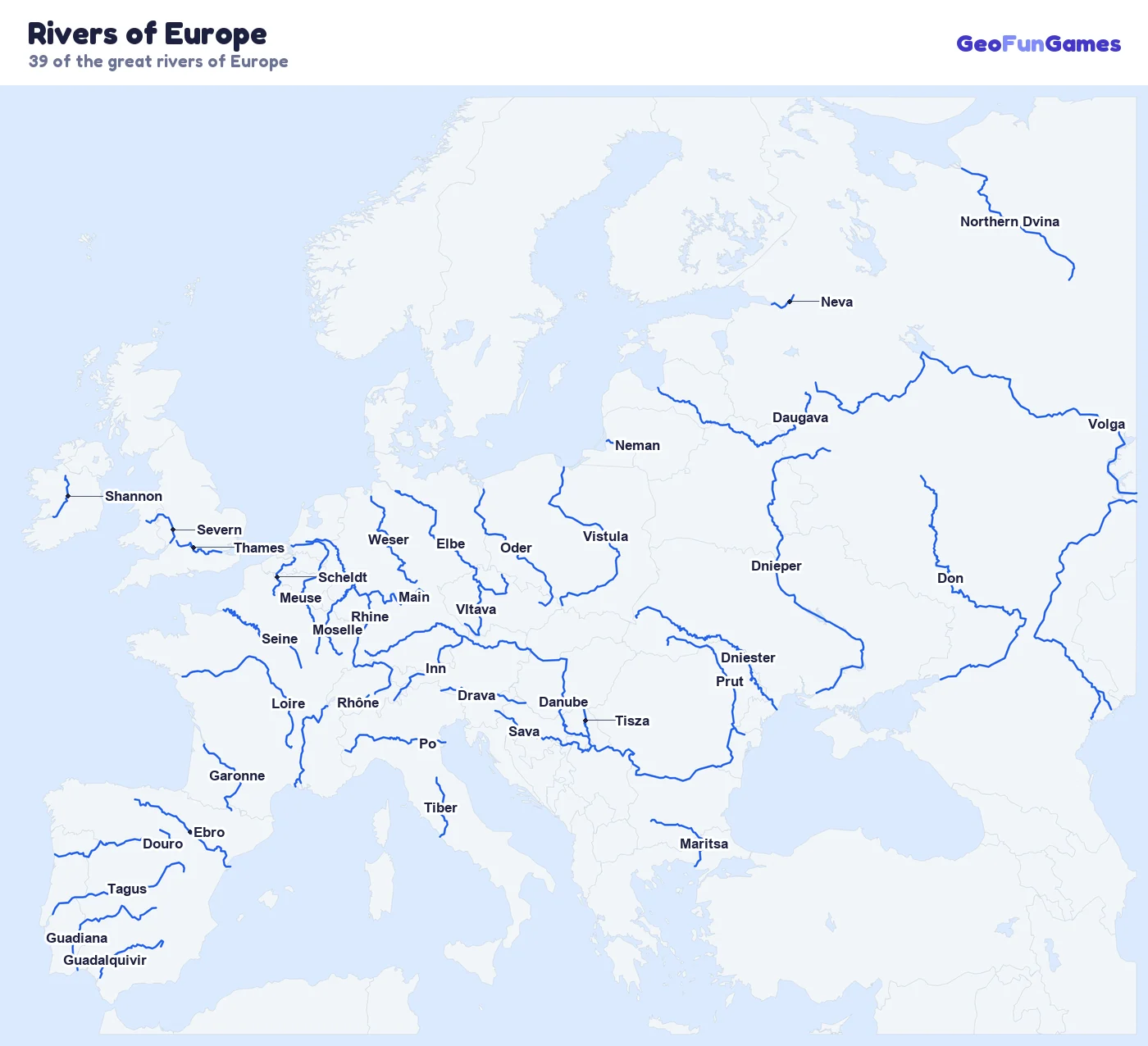
From the Thames to the Volga. Print the map, download it as a PDF, or use the blank map to practise.
About this map
Europe's great cities grew up on its rivers: Vienna, Budapest and Belgrade on the Danube, Paris on the Seine, London on the Thames and Cologne on the Rhine. For centuries rivers were the fastest way to move people and goods, and many still carry barges today.
Several rivers also mark borders. The Danube separates Romania from Bulgaria for much of its length, the Oder forms part of the border between Germany and Poland, and the Rhine divides France from Germany near Strasbourg.
Key facts
The Volga is the longest
At about 3,530 km, the Volga flows through Russia into the Caspian Sea. It is the longest river in Europe.
The Danube crosses ten countries
The Danube (about 2,850 km) flows through or along ten countries and four capitals: Vienna, Bratislava, Budapest and Belgrade.
The Rhine is the busiest
The Rhine runs about 1,230 km from the Swiss Alps to the North Sea near Rotterdam and is Europe's busiest inland waterway.
The Loire is France's longest
At about 1,000 km, the Loire is the longest river in France, famous for the castles along its valley.
Short but famous
The Thames is only about 346 km long, yet it is one of the best-known rivers in the world because it flows through London.
All 39 rivers on the map
Level 1
The famous rivers, like the Danube, Rhine, Thames and Seine
- Danube
- Rhine
- Volga
- Thames
- Seine
- Loire
- Rhône
- Elbe
- Po
- Tagus
- Dnieper
- Vistula
- Oder
Level 2
The next 13 rivers, like the Ebro, Weser and Tiber
- Ebro
- Douro
- Garonne
- Weser
- Main
- Moselle
- Meuse
- Tiber
- Shannon
- Don
- Dniester
- Daugava
- Guadalquivir
Level 3
Smaller rivers and tributaries, like the Sava, Inn and Vltava
- Severn
- Guadiana
- Sava
- Drava
- Tisza
- Inn
- Vltava
- Neman
- Prut
- Maritsa
- Northern Dvina
- Neva
- Scheldt
How to learn them
Learn the rivers by the sea they flow into. To the North Sea: the Rhine, Elbe, Weser, Thames and Scheldt. To the Baltic: the Vistula, Oder, Neman, Daugava and Neva. To the Black Sea: the Danube, Dnieper and Dniester. To the Mediterranean: the Rhône, Po, Ebro and Tiber. To the Atlantic: the Loire, Tagus, Douro, Guadalquivir and Shannon. Tributaries are easier once you know the main river: the Sava, Drava, Tisza, Inn and Prut all join the Danube, and the Main and Moselle join the Rhine.
Test yourself
Find every place on the map in the quiz, level by level.
Play the quizQuestions
What is the longest river in Europe?
The Volga, at about 3,500 km, flowing through Russia into the Caspian Sea. The Danube is second (about 2,850 km) and flows through or along ten countries, more than any other river in the world.
Which river flows through the most capital cities?
The Danube, through four: Vienna, Bratislava, Budapest and Belgrade. No other river in the world passes so many capitals.
Which rivers flow into the North Sea?
The Rhine, Elbe, Weser, Thames and Scheldt, along with the Meuse, which reaches the sea through the Rhine delta.
What is the longest river in the European Union?
The Danube. The Volga is longer, but it lies entirely in Russia.